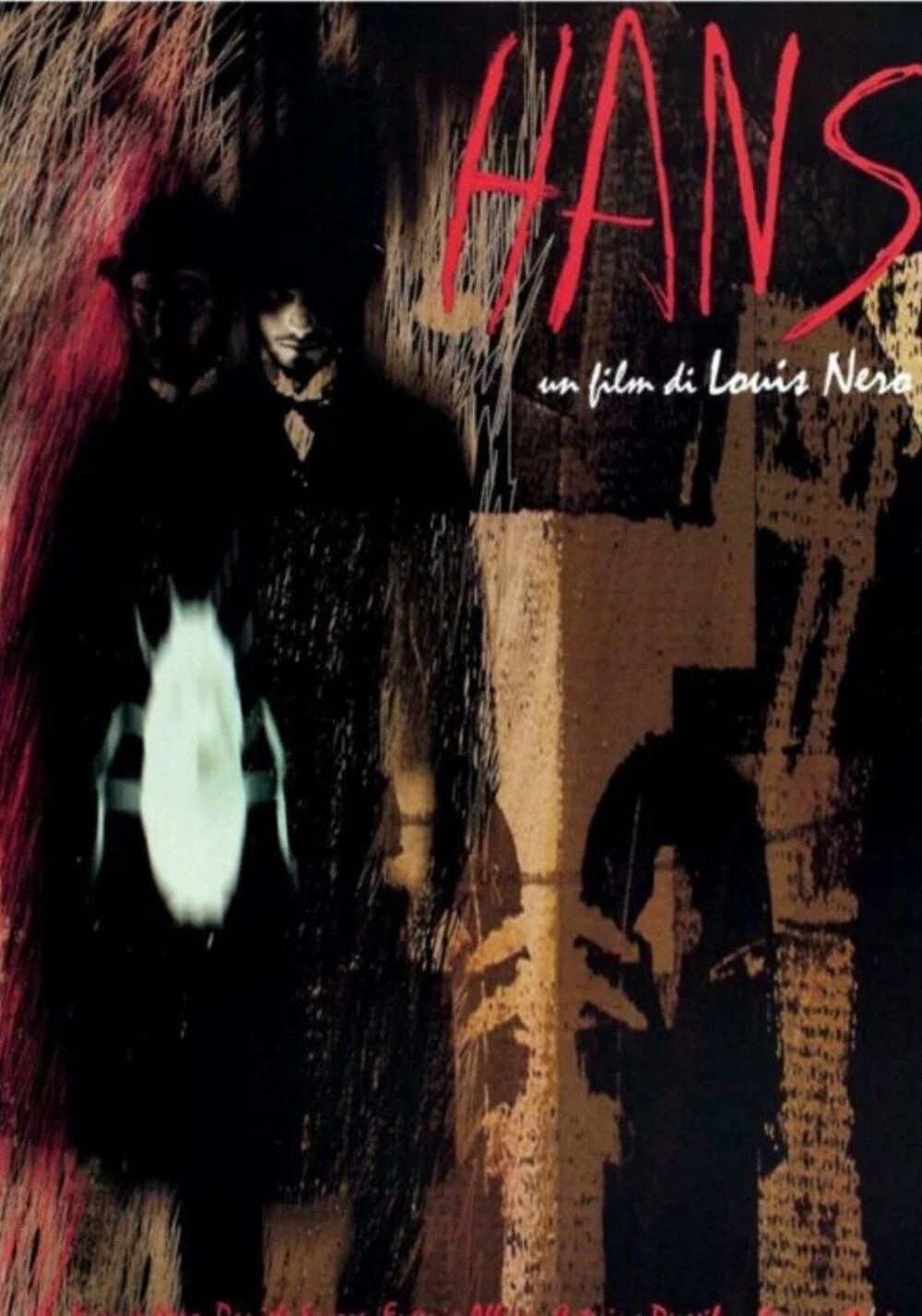
Hans revolves around the life of a man named Hans, who becomes entangled in a web of psychological turmoil. The film is a profound examination of his descent into madness, exploring the intricate layers of his psyche through a series of surreal and often disturbing scenes. Set against the backdrop of Freud’s theories, the film blends reality with the subconscious, creating a mesmerizing narrative that challenges conventional storytelling.
Cast
Daniele Savoca, Franco Nero, Simona Nasi, Silvano Agosti, Eugenio Allegri, Caterina De Regibus, Lola Gonzales, Sax Nicosia, Walter Saccu, Giuseppe Cesario
Director
Louis Nero
Producer
Louis Nero
Streaming
DVD
Discover our gallery
A descent into the fractured mind
Hans is built as an immersion into psychological disintegration, following a protagonist whose perception of reality becomes increasingly unstable. Rather than observing mental illness from a distance, the film is presented as an inner journey through paranoia, fear, and fragmentation, placing the viewer inside the unstable world of Hans Schabe. This approach gives the film its disturbing force, transforming psychological crisis into the very structure of the experience.
Inspired by Kafka and the language of transformation
One of the key dimensions of Hans is its declared connection to Franz Kafka’s Metamorphosis. Public sources describe the film as being based on that literary universe, and this reference helps explain its sense of alienation, bodily unease, and social estrangement. The protagonist’s surname, Schabe, reinforces this Kafkaesque tension, turning the film into a story where identity itself appears degraded, distorted, and pushed toward symbolic collapse.
Freud, hysteria, and the unconscious
Hans is also shaped by a strong Freudian influence. Available descriptions explicitly connect the film to Freud’s theories on hysteria, framing the narrative as an exploration of repression, psychosis, and the subconscious. This gives the film a distinctive intellectual and symbolic texture, because the protagonist’s breakdown is not treated only as pathology, but as a passage through deeper psychic forces that unsettle the boundary between self and world.
Between absurdist theatre and psychological thriller
Another striking feature of Hans is the way it draws from the theatre of the absurd, particularly through references to Adamov, while still remaining rooted in thriller territory. This combination gives the film an unusual tone, suspended between mental collapse, symbolic staging, and dramatic tension. Instead of following a purely realistic path, Louis Nero builds a world where perception is unstable and where the absurd becomes a language for expressing fear, alienation, and existential unease.
A first-person vision of madness and exclusion
Sources on the film emphasize that Hans’s schizophrenia is narrated in the first person rather than from an external clinical perspective. This choice makes Hans more intimate and more disturbing, because the audience is not invited to judge the protagonist from outside, but to inhabit his unstable experience directly. Some critical material also reads the film as a metaphor for everyday racism and social hostility, extending Hans’s inner collapse into a broader reflection on fear projected onto the other.
An early Louis Nero film of strong symbolic ambition
Within Louis Nero’s early filmography, Hans stands out as a work of strong formal and thematic ambition. Produced with support from Film Commission Torino Piemonte and shot in 2005, the film combines literary influence, psychological inquiry, and symbolic staging in a way that already points toward the director’s later interest in metaphysical tension and unconventional cinematic form. More than a genre exercise, Hans emerges as an unsettling reflection on madness, identity, and the fragile threshold between human consciousness and social nightmare.
We use cookies to ensure that we give you the best experience on our website. If you continue to use this site we will assume that you are happy with it.